Recall Training for Dobermans: Teaching a Reliable Come Command

Recall Training for Dobermans: Teaching a Reliable Come Command
A reliable recall may be the most important command your Doberman ever learns. Whether your dog slips out of the front door, becomes distracted at the park, or finds itself in a potentially dangerous situation, a strong recall command can prevent accidents and even save your dog’s life.
Unfortunately, many Doberman owners struggle with recall training. Their dog comes when called inside the house but completely ignores them outdoors. Others find that their Doberman responds only when there are no distractions nearby.
The good news is that Dobermans are highly intelligent, eager to learn, and capable of developing an exceptionally reliable recall when trained correctly. The key is understanding how dogs learn and building the behavior gradually through consistent practice.
In this guide, you’ll learn how to teach a reliable come command, avoid common recall mistakes, train around distractions, and create a Doberman that happily returns when called.
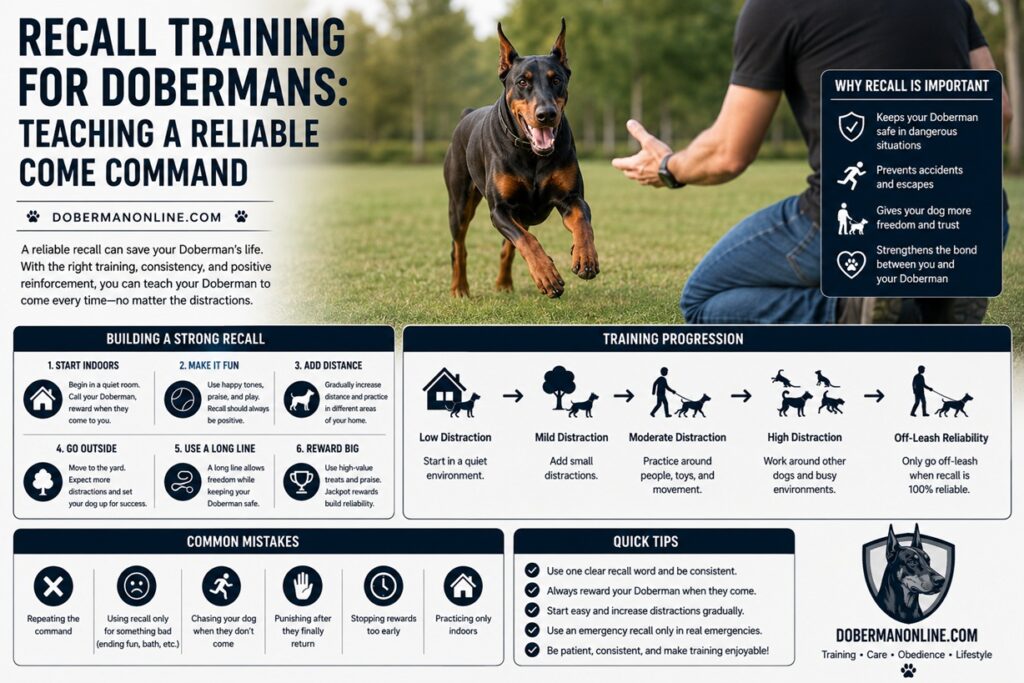
Why Recall Training Is So Important
Many obedience commands improve convenience.
Recall improves safety.
A reliable recall can help when:
- Your Doberman escapes the yard
- A leash accidentally breaks
- Wildlife appears during a walk
- Your dog approaches a road
- You need immediate control in an emergency
Because Dobermans are athletic and fast, a weak recall can quickly become dangerous.
Teaching your dog to return immediately when called should be a priority from an early age.
What Is a Reliable Recall?
A reliable recall means your dog:
- Immediately responds to the command
- Turns toward you
- Returns without hesitation
- Remains engaged until released
A recall is not considered reliable if your dog:
- Comes only when it wants to
- Responds inconsistently
- Returns slowly
- Requires multiple commands
The goal is creating a response that works in real-world situations, not just inside your home.
When Should Recall Training Begin?
Recall training should begin as soon as your Doberman puppy arrives home.
Young puppies naturally enjoy following their owners, making this the easiest stage for developing strong habits.
If you’ve recently welcomed a puppy, our guide on Doberman Puppy Training: The Ultimate First 6 Months Guide covers additional foundational training exercises that support recall success.
The earlier you begin, the easier the process becomes.
Choosing Your Recall Command
Many owners simply use:
“Come”
Others prefer:
- Here
- Front
- To Me
- Return
The exact word does not matter.
What matters is consistency.
Choose one command and use it throughout your dog’s life.
Avoid constantly changing recall words.
Building Positive Associations
The recall command should always predict something positive.
When your Doberman hears the command, it should think:
“Something good happens when I go to my owner.”
This positive expectation dramatically increases reliability.
High-Value Rewards
For recall training, ordinary kibble is often not enough.
Use rewards your dog truly loves:
- Chicken
- Turkey
- Cheese
- Freeze-dried treats
- Favorite toys
The more valuable the reward, the stronger the motivation.
Step 1: Start Indoors
Begin training inside a quiet room.
Stand a short distance away.
Say your recall command once.
For example:
“Come!”
As your Doberman moves toward you:
- Praise enthusiastically
- Reward immediately
- Make the experience fun
Repeat several times daily.
Short sessions work best.
Step 2: Create a Game
Dobermans learn quickly through games.
The Recall Chase Game
Move away from your dog while calling them.
Most puppies instinctively chase.
When your dog reaches you:
- Reward generously
- Offer praise
- Continue playing
This builds enthusiasm for returning.
Your Doberman should view recall as exciting rather than restrictive.
Step 3: Increase Distance
Once your dog responds consistently indoors:
- Move farther away
- Practice in larger rooms
- Add mild distractions
Gradually increase difficulty while maintaining a high success rate.
Avoid advancing too quickly.
Success builds confidence.
Step 4: Practice in the Yard
After reliable indoor responses, move training outdoors.
Your backyard introduces:
- New smells
- Environmental sounds
- Visual distractions
Expect performance to decrease initially.
This is normal.
Dogs do not automatically transfer behaviors from one environment to another.
Keep sessions short and rewarding.
Using a Long Training Line
A long line is one of the most valuable recall training tools available.
Typical lengths include:
- 15 feet
- 20 feet
- 30 feet
The long line allows freedom while maintaining safety.
Benefits include:
- Preventing self-rewarding failures
- Increasing control
- Building confidence
- Practicing real-world recall safely
Never begin off-leash training before your dog demonstrates reliability on a long line.
Reward Every Successful Recall
Many owners make a critical mistake.
They stop rewarding once the dog understands the command.
Rewards should continue.
Although you may reduce frequency later, occasional rewards maintain enthusiasm and reliability.
Your Doberman should never know when a jackpot reward is coming.
This uncertainty keeps motivation high.
The Power of Jackpot Rewards
Sometimes offer:
- Several treats
- Extended praise
- A favorite toy
- A short game
Large rewards create memorable learning experiences.
Use jackpot rewards for exceptional recalls or difficult situations.
Never Punish a Recall
This is one of the most important rules in dog training.
Never punish your Doberman after it comes to you.
For example:
- Calling your dog before a bath
- Calling your dog before nail trimming
- Calling your dog and then scolding it
These experiences teach the dog that coming to you predicts unpleasant outcomes.
A damaged recall can take months to rebuild.
Avoid Repeating Commands
Many owners unintentionally train their dogs to ignore them.
Instead of saying:
“Come. Come. Come. Come.”
Give the command once.
Then help your dog succeed.
Repeating commands weakens their meaning.
Your recall word should always remain important.
Building Reliability Around Distractions
Distractions are where recall training truly begins.
A dog that recalls inside the house has learned the basics.
A dog that recalls away from distractions has learned reliability.
Gradually introduce:
- Family members
- Toys
- Food bowls
- Other dogs
- New environments
Increase difficulty slowly.
Always maintain a high success rate.
Introducing an Emergency Recall Command
Many experienced trainers teach a separate emergency recall.
This command is reserved for situations where immediate compliance is critical.
Examples include:
- Escaping through an open gate
- Running toward traffic
- Chasing wildlife
- Dangerous off-leash situations
Choose a unique word such as:
- Emergency
- Now
- Here Now
Only use this command when absolutely necessary.
Always reward with something extraordinary.
Examples include:
- Several pieces of chicken
- A favorite toy
- A long play session
The emergency recall should always predict the best reward your Doberman can imagine.
Training Recall Around Other Dogs
One of the biggest challenges for Doberman owners is recalling their dog away from another dog.
Most failures occur because owners attempt this too early.
Instead:
- Begin at a distance.
- Call your dog before excitement escalates.
- Reward heavily.
- Gradually decrease distance over time.
Success comes from managing difficulty rather than testing obedience.
Remember:
Training is not proving what your dog knows.
Training is teaching your dog how to succeed.
Off-Leash Recall Training
Every Doberman owner dreams of reliable off-leash control.
However, off-leash freedom must be earned.
Before removing the long line, your Doberman should consistently recall:
- In different locations
- Around distractions
- Around people
- Around other dogs
- During exciting situations
If reliability drops below 90 percent, additional practice is needed.
Rushing this stage often creates long-term setbacks.
Real-Life Recall Drills
Structured exercises improve reliability.
Hide and Seek
When your dog is distracted:
- Move behind a tree
- Hide briefly
- Call your dog
This game encourages attention and reinforces the habit of checking in.
Recall Between Family Members
Two people stand apart.
Take turns calling the dog.
Reward every successful response.
Most Dobermans love this game.
Recall During Walks
Occasionally call your dog during a walk.
Reward generously.
Then allow the walk to continue.
This prevents your dog from associating recall with the end of fun.
Common Recall Training Mistakes
Calling Only When Something Bad Happens
Many dogs learn:
Recall = fun ends.
Avoid using recall exclusively for:
- Going home
- Bath time
- Crate time
- Nail trimming
Instead, frequently call your dog, reward them, and then release them to continue enjoying themselves.
Training Too Quickly
Progressing too fast often leads to failure.
Increase distractions gradually.
Success should always outweigh mistakes.
Becoming Angry
If your dog ignores the command:
Do not yell.
Do not chase.
Do not punish.
Focus on reducing difficulty and rebuilding reliability.
Practicing Only Indoors
Real-world recall requires real-world practice.
Train in:
- Backyards
- Parks
- Open fields
- New environments
Dogs learn contextually.
Stopping Rewards Too Early
Even highly trained Dobermans benefit from occasional rewards.
Reinforcement maintains long-term reliability.
Recall Training for Adult Dobermans
Adult Dobermans can absolutely learn a strong recall.
The process remains the same:
- Build positive associations
- Reward generously
- Increase distractions gradually
- Practice consistently
Older dogs may require more patience if they have a history of ignoring recall commands.
However, Dobermans are intelligent enough to learn new habits at any age.
How Long Does Recall Training Take?
There is no universal timeline.
Factors include:
- Age
- Previous training
- Consistency
- Environment
- Individual temperament
Some puppies show reliable responses within weeks.
Others may require several months of structured practice.
The goal should never be speed.
The goal should be reliability.
Signs Your Recall Is Improving
Watch for:
- Faster responses
- Fewer repeated commands
- Increased enthusiasm
- Better focus outdoors
- More consistent returns around distractions
These small improvements indicate progress.
Reliable recall is built one successful repetition at a time.
Creating a Lifetime Habit
Recall is not something you teach once and forget.
Even highly trained Dobermans benefit from regular practice.
Incorporate recall into daily life:
- During walks
- In the backyard
- During play sessions
- Around family members
Frequent practice keeps the behavior strong and dependable.
As your Doberman matures, a reliable recall becomes one of the most valuable skills you can develop. Combined with proper socialization and obedience training, it creates a safer, more enjoyable relationship built on trust, communication, and responsiveness.
For additional obedience exercises, visit our Doberman Training Guide: Comprehensive Obedience & Behavior and our Doberman Socialization: Essential Rules to Prevent Aggression guide.
A reliable recall is one of the foundations of advanced obedience. Once your Doberman consistently returns when called, you can begin working on more advanced skills such as heel, place, extended stays, and off-leash control.
At what age should I start recall training my Doberman?
Recall training should begin as soon as your Doberman puppy comes home, typically between 8 and 10 weeks of age. Early training helps establish strong habits before distractions become more challenging.
What is the best recall command for a Doberman?
The best recall command is the one you use consistently. Common choices include “Come,” “Here,” or “To Me.” Consistency is more important than the specific word you choose.
How do I make my Doberman come when called?
Use positive reinforcement, high-value rewards, and regular practice. Start in low-distraction environments and gradually increase difficulty as your dog’s reliability improves.
Why does my Doberman ignore me outside?
Outdoor environments contain distractions such as smells, people, wildlife, and other dogs. Your Doberman may understand the command but need additional training to perform reliably around distractions.
Should I use treats for recall training?
Yes. High-value treats are one of the most effective tools for building a reliable recall. Rewarding successful responses helps create a strong positive association with returning to you.
Can I teach recall to an adult Doberman?
Absolutely. Adult Dobermans can learn a reliable recall at any age. Consistent practice, patience, and positive reinforcement are the keys to success.
What is an emergency recall?
An emergency recall is a special command reserved for dangerous situations. It should be paired with exceptional rewards and used only when immediate compliance is critical.
How long does recall training take?
Some Dobermans show significant improvement within a few weeks, while others require several months of consistent practice. The timeline depends on age, experience, distractions, and training consistency.
Can I trust my Doberman off leash?
Off-leash freedom should only be considered after your dog demonstrates reliable recall in multiple environments and around various distractions. A long training line should be used before transitioning to off-leash work.
What are the most common recall training mistakes?
Common mistakes include repeating commands, punishing the dog after it comes, training too quickly, stopping rewards too early, and practicing only in low-distraction environments.




In-depth information