How to Feed a Doberman Puppy: A Complete Growth Guide

How to Feed a Doberman Puppy: A Clinical Guide to Optimal Skeletal and Muscular Growth
The developmental phase of a Doberman Pinscher puppy is a rapid, high-metabolic process that requires strict nutritional precision. As a large-breed working canine, a Doberman experiences intense musculoskeletal expansion within the first 12 to 18 months of life. Nutritional management during this critical window does not merely fuel daily kinetic energy; it establishes the foundation for immunological defense, structural integrity, and long-term cardiac health.
Inappropriate nutritional protocols during puppyhood are primary catalysts for juvenile orthopedic diseases, gastrointestinal imbalances, and metabolic disorders. This clinical guide outlines the macro-nutrient requirements and feeding methodologies formulated by our veterinary research board.

1. Why Large-Breed Juvenile Nutrition is Critical
Doberman puppies possess a genetic predisposition for rapid structural growth. Unlike small breeds, their skeletal development must be carefully regulated rather than accelerated.
-
Skeletal Homeostasis: Excess caloric intake forces the puppy’s body mass to increase faster than their skeletal matrix can support. This kinetic imbalance significantly elevates the risk of Hip Dysplasia, Osteochondritis Dissecans (OCD), and Panosteitis.
-
Immunological and Enteric Support: A precisely balanced diet fortifies the gut microbiome, which houses approximately 70% of the canine’s immune system, ensuring resilience against pathogens during the vulnerable post-weaning window.
2. Feeding Frequency and Chronobiological Scheduling
Because a puppy’s gastric capacity is limited, dividing the daily caloric ration into multiple intervals prevents gastrointestinal distress and stabilizes blood glucose curves.
2 to 3 Months of Age (Post-Weaning Phase)
-
Frequency: 4 meals per day.
-
Clinical Goal: Accommodate a highly restricted gastric volume while maintaining metabolic equilibrium.
3 to 6 Months of Age (Peak Growth Phase)
-
Frequency: 3 meals per day.
-
Clinical Goal: Supply the heavy caloric demands of rapid osteological extension without overloading the stomach.
6 to 12 Months of Age (Transition Phase)
-
Frequency: 2 to 3 meals per day.
-
Clinical Goal: Support ongoing muscle mass synthesis as the digestive tract matures.
12 Months and Beyond (Adult Maintenance)
-
Frequency: 2 meals per day.
-
Clinical Goal: Transition to an adult metabolic routine designed to mitigate gastric torsion risks.
3. Formulating the Ideal Macro-Nutrient Profile
When evaluating commercial diets or custom formulations for a juvenile Doberman, the ingredient architecture must meet rigorous large-breed standards:
-
Premium Animal Protein Architecture: The primary ingredient must be highly bioavailable animal protein (such as chicken, beef, or lamb). The total crude protein content should range ideally between 26% and 30% to support myofibrillar (muscle) synthesis.
-
The Calcium-to-Phosphorus Ratio: This is the most critical metric in large-breed nutrition. The absolute calcium level must be strictly regulated between 1.1% and 1.5%, with a precise Calcium-to-Phosphorus ratio maintained around 1.1:1 to 1.3:1. Deviating from this ratio frequently induces metabolic bone disease.
-
Lipid Optimization: Diets must include rich sources of Omega-3 and Omega-6 fatty acids, specifically DHA (Docosahexaenoic Acid), to maximize neurological differentiation and retinal development.
4. Quantitative Dietary Guidelines (Portion Management)
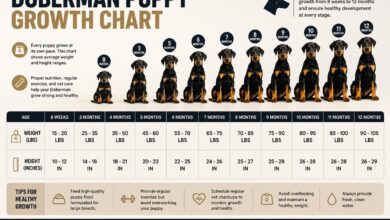
Daily caloric volume depends strictly on the metabolizable energy (kcal/kg) of the chosen diet, alongside the puppy’s individual metabolic rate. However, the following chart provides a standardized clinical baseline for daily intake of high-quality large-breed puppy kibble:
| Age (Months) | Average Daily Ration Baseline (Grams) |
| 2 Months | 180 – 250 g |
| 3 Months | 250 – 320 g |
| 4 Months | 300 – 400 g |
| 5 Months | 350 – 450 g |
| 6 Months | 400 – 550 g |
⚠️ Clinical Note: Avoid feeding purely by volumetric visualization. Utilize a digital scale to measure portions precisely, and perform routine Body Condition Scoring (BCS) to ensure the puppy maintains a lean, aerodynamic silhouette where the ribs are easily palpable but not visually prominent.
5. Prohibited Elements and Feeding Malpractices
Domestic table scraps, unformulated raw diets, and erratic feeding schedules introduce severe biosecurity and metabolic risks.
-
Toxic Substrates: All forms of alliums (onions, garlic), sodium-heavy processed foods, cooked bones (which cause gastrointestinal perforation), and grapes/raisins must be strictly prohibited.
-
The Peril of Premature Adult Transition: Transitioning a Doberman puppy to an adult maintenance diet prior to 12–15 months deprives their skeletal structure of essential amino acids and micronutrients, severely stunting physiological potential.
FAQ: Frequently Asked Questions
Can a Doberman puppy ingest bovine milk post-weaning?
No. Following weaning, canines naturally downregulate the production of the lactase enzyme. Introducing bovine (cow) milk frequently induces osmotic diarrhea, intestinal inflammation, and systemic nutrient malabsorption.
Is it safe to integrate whole eggs into a Doberman puppy’s diet?
Yes, provided the egg is thoroughly cooked. Boiled eggs supply a highly bioavailable amino acid profile and essential lipids. However, they must be administered sparingly as occasional dietary enrichment, never exceeding 10% of the daily caloric allowance.
When should a juvenile Doberman transition to adult maintenance formulas?
Large breeds like the Doberman Pinscher reach skeletal maturity later than smaller breeds. The transition to an adult formulation should occur between 12 and 18 months of age, ideally under the biometric guidance of a clinical veterinarian.