When Is a Doberman Fully Grown? Complete Growth Timeline by Age (2026 Guide)

When Is a Doberman Fully Grown? Complete Growth Timeline by Age (2026 Guide)
Many new owners believe their Doberman is fully grown once it reaches its first birthday. While your dog may appear adult-sized by 12 months, the reality is more complex. Physical growth, muscle development, skeletal maturity, and mental behavior all continue well beyond the first year.
Understanding your Doberman’s growth stages helps you provide the right nutrition, exercise, training, and veterinary care at every age. It also reduces the risk of injuries caused by overexercising a puppy whose bones and joints are still developing.
In this complete guide, you’ll learn exactly when Dobermans stop growing, how males and females develop differently, what influences their final size, and how to support healthy growth from puppyhood into adulthood.
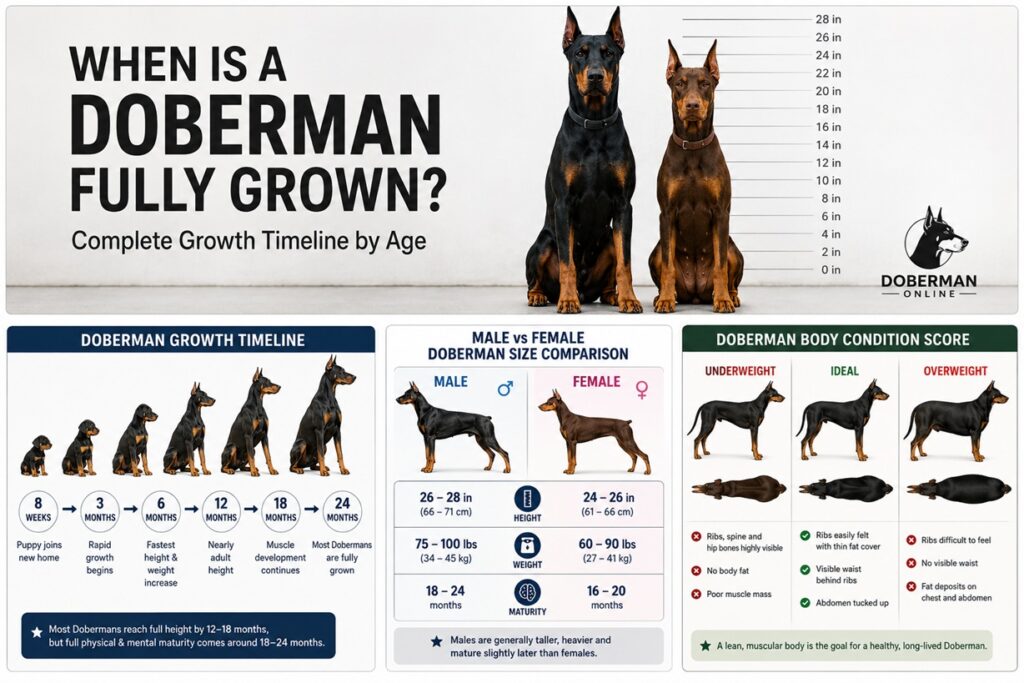
Doberman Growth Timeline at a Glance
Every Doberman grows at a slightly different pace, but most follow a similar development pattern.
| Age | Development Stage |
|---|---|
| 8 Weeks | Puppy joins new home |
| 3 Months | Rapid growth begins |
| 4–6 Months | Fastest height and weight increase |
| 6–9 Months | Legs become longer, body fills out |
| 10–12 Months | Nearly adult height |
| 12–18 Months | Muscle development continues |
| 18–24 Months | Mental maturity improves |
| Around 2 Years | Most Dobermans are fully grown |
Quick Answer
Most Dobermans reach their full height between 12 and 18 months, but they usually continue gaining muscle, chest width, and overall maturity until 18–24 months of age.
Large males often take slightly longer than females to fully mature.
Doberman Growth From 8 Weeks to 6 Months
The first six months represent the fastest period of growth in a Doberman’s life.
During this stage, puppies can gain several pounds every week while their bones, muscles, joints, and internal organs develop rapidly.
Want to see how your puppy should grow each month? Read our complete Doberman Puppy Growth Chart: Weight & Height Guide by Age for detailed monthly milestones
Owners should focus on providing:
- High-quality puppy nutrition
- Controlled exercise
- Proper socialization
- Positive reinforcement training
- Regular veterinary checkups
Avoid excessive running, jumping, or repetitive impact activities because growth plates are still open.
At this age, puppies are naturally curious and energetic, making consistent training especially important.
8 to 12 Weeks
Your Doberman puppy has just entered one of the most important learning periods.
Typical characteristics include:
- Rapid learning ability
- Growing confidence
- Baby teeth
- Limited bladder control
- High sleep requirements (18–20 hours daily)
This is the ideal time to introduce:
- Household routines
- Basic obedience
- Crate training
- Gentle socialization
- Positive experiences with people and environments
3 to 4 Months
Growth becomes much more noticeable.
Many puppies begin looking taller almost every week.
You may notice:
- Long legs
- Oversized paws
- Increased appetite
- More energy
- Faster learning
Owners often wonder if their Doberman is becoming “too skinny.”
In most cases, a lean body condition is completely normal during this rapid growth phase.
4 to 6 Months
This is usually the fastest physical growth stage.
Dobermans may gain:
- Significant height
- Lean muscle
- Stronger bones
- Improved coordination
Teething is also reaching its peak.
Providing safe chew toys helps reduce destructive chewing while protecting developing teeth.
Avoid forcing long-distance running during this period since the joints are still vulnerable.
Doberman Growth Between 6 and 12 Months
Between six and twelve months, your Doberman begins looking much more like an adult dog.
However, appearances can be misleading.
Although they may already stand close to their adult height, many important developmental processes are still occurring beneath the surface.
These include:
- Bone strengthening
- Joint stabilization
- Muscle growth
- Chest expansion
- Hormonal development
- Brain maturity
This stage often surprises first-time owners because their dog looks fully grown but still behaves like an energetic puppy.
A balanced training routine combined with appropriate nutrition becomes especially important during this period.
Physical Changes
From six months onward, growth gradually slows compared to earlier puppyhood.
Instead of growing taller every week, your Doberman begins developing a stronger body.
You may notice:
- A broader chest
- More defined muscles
- A thicker neck
- Improved coordination
- Increased athletic ability
The puppy’s awkward proportions also begin to disappear.
Long legs become better balanced with the rest of the body, giving the Doberman its elegant and athletic appearance.
Behavioral Development
Around this age, adolescence begins.
Common behaviors include:
- Testing boundaries
- Selective listening
- Increased independence
- High energy levels
- Curiosity
- Strong desire to explore
This is completely normal.
Consistent training, patience, and daily mental stimulation help prevent unwanted behaviors from becoming long-term habits.
What Happens Between 12 and 24 Months?
One of the biggest misconceptions about Dobermans is that they stop growing once they celebrate their first birthday. While most Dobermans have reached nearly their full height by 12 months, they are still developing physically and mentally.
Between one and two years of age, your Doberman transitions from adolescence into adulthood. During this period, changes become more subtle than during puppyhood, but they are just as important.
Instead of growing taller, your dog begins to mature in several other ways.
These include:
- Increased muscle mass
- A broader and deeper chest
- Stronger shoulders and hindquarters
- Better coordination
- Improved endurance
- More balanced behavior
Many owners notice that their Doberman starts looking more powerful during this stage, even though the scale shows only small increases in weight.
This is completely normal and reflects healthy muscle development rather than rapid growth.
Muscle Development Continues
Dobermans are naturally athletic dogs.
Their lean, muscular appearance does not develop overnight.
Between 12 and 24 months, most dogs continue adding muscle across their:
- Neck
- Chest
- Shoulders
- Back
- Hind legs
Males generally gain more muscle than females, giving them a noticeably larger and more powerful appearance.
Regular exercise combined with proper nutrition helps support healthy muscle development without placing unnecessary stress on the joints.
The Chest Continues to Expand
Many owners become concerned because their one-year-old Doberman still appears narrow.
In reality, the chest continues widening throughout the second year.
This gradual development gives adult Dobermans the deep chest and athletic silhouette that the breed is known for.
It is one reason why a 14-month-old Doberman often looks much different than the same dog at 24 months.
Mental Maturity Develops More Slowly
Physical growth usually finishes before emotional maturity.
Even a large Doberman may still behave like a playful puppy well into its second year.
Owners commonly notice:
- Bursts of excitement
- Playful behavior
- Short attention span
- Occasional stubbornness
- Endless curiosity
With consistent training and daily structure, these behaviors gradually become more controlled as the dog reaches adulthood.
Male vs Female Doberman Growth
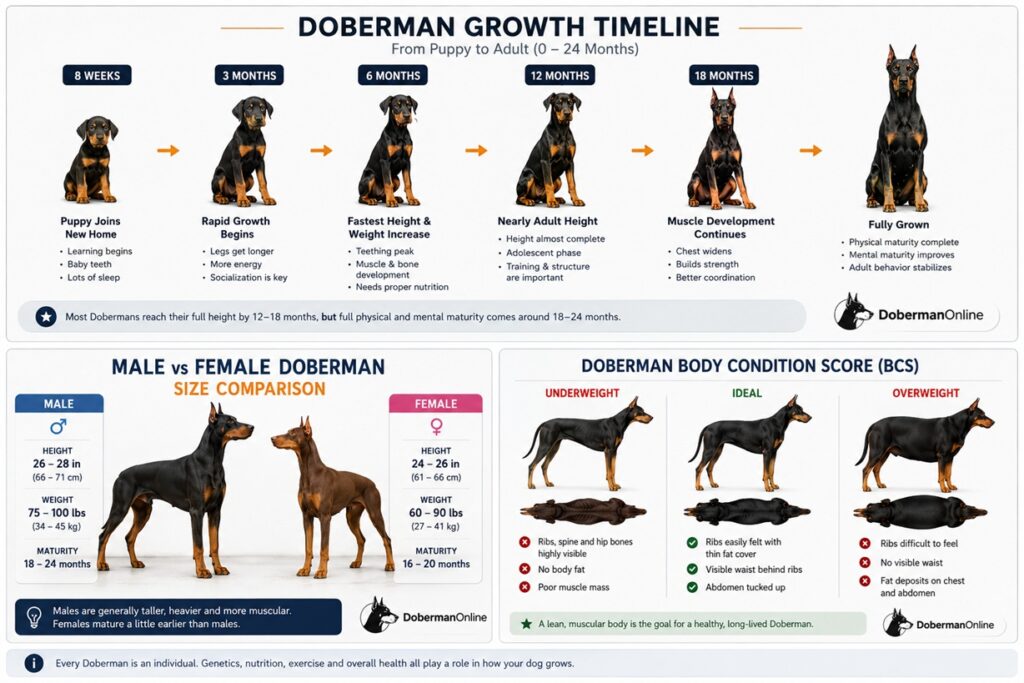
Although male and female Dobermans follow similar developmental stages, they mature at slightly different rates.
Females typically mature earlier and remain somewhat smaller throughout adulthood.
Males usually continue building muscle and body mass for several additional months.
| Growth Stage | Male | Female |
|---|---|---|
| Full Height | 12–18 months | 10–14 months |
| Muscle Development | Up to 24 months | Around 18–20 months |
| Mental Maturity | 18–24 months | 16–20 months |
Individual genetics always play a role, so these ages should be considered averages rather than exact milestones.
Average Adult Height and Weight
Adult Dobermans are classified as large-breed dogs with a lean, athletic body.
Healthy adults generally fall within the following ranges.
| Sex | Height | Weight |
|---|---|---|
| Male | 26–28 inches (66–71 cm) | 75–100 lbs (34–45 kg) |
| Female | 24–26 inches (61–66 cm) | 60–90 lbs (27–41 kg) |
Remember that body condition is far more important than weight alone.
A fit Doberman should have:
- A visible waist
- A tucked abdomen
- Easily felt ribs beneath a thin layer of muscle
- Well-developed shoulders and hindquarters
Dogs carrying excessive body fat may appear larger but are at greater risk of joint disease, heart problems, and reduced mobility.
When Do Doberman Growth Plates Close?
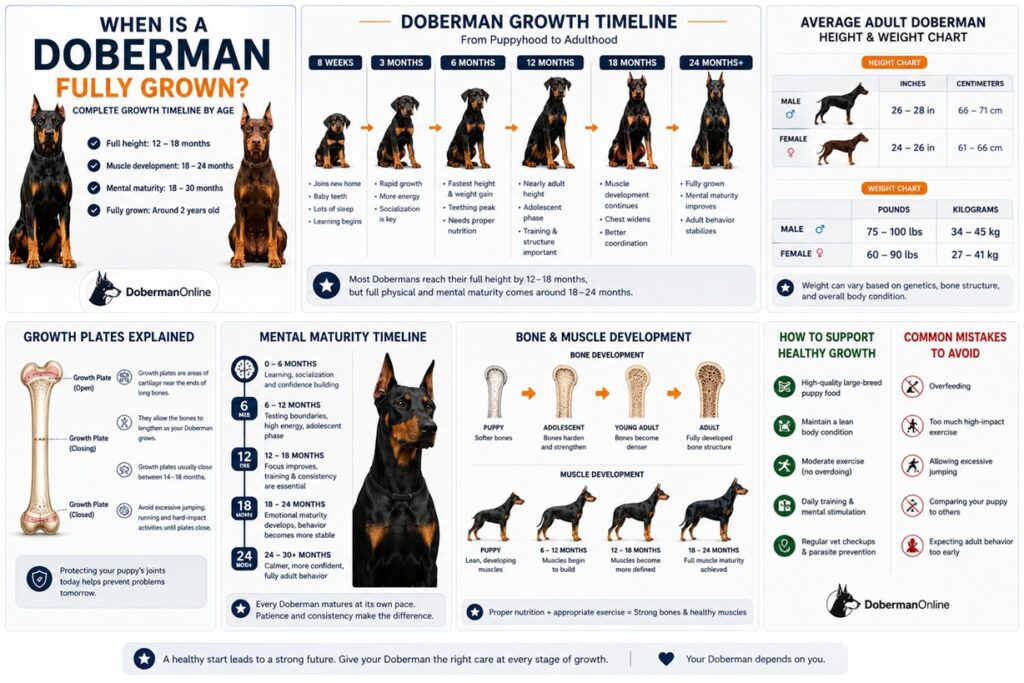
Growth plates are areas of soft cartilage located near the ends of a puppy’s long bones.
As your Doberman matures, these plates gradually harden into solid bone.
Once the growth plates close, the bones stop lengthening.
For most Dobermans, growth plates finish closing between 14 and 18 months, although larger males may continue developing until approximately 20 months.
Until this process is complete, owners should avoid activities that place excessive stress on developing joints.
Examples include:
- Repetitive jumping
- Long-distance running
- Agility competitions
- Running beside bicycles
- Frequent stair climbing for very young puppies
Instead, choose controlled exercise such as walks, gentle play sessions, obedience training, and supervised free movement.
Proper joint protection during the first year may reduce the risk of orthopedic injuries later in life.
Physical Maturity vs Mental Maturity
One of the most important things for Doberman owners to understand is that physical maturity and mental maturity are not the same.
A Doberman may reach its adult height before its first birthday, yet still think and behave like an adolescent for many more months.
This difference explains why many one-year-old Dobermans are full of energy, easily distracted, and sometimes appear stubborn despite looking like fully grown adults.
Understanding this normal developmental stage helps owners set realistic expectations and remain consistent with training.
Physical Maturity
Physical maturity refers to the completion of your Doberman’s body development.
This includes:
- Full adult height
- Adult body weight
- Closed growth plates
- Mature bone structure
- Fully developed muscles
- Adult coat condition
Most Dobermans reach physical maturity between 18 and 24 months.
However, larger males may continue filling out slightly beyond their second birthday.
Mental Maturity
Mental maturity develops much more gradually.
As your Doberman matures emotionally, you may notice improvements in:
- Impulse control
- Focus during training
- Confidence
- Emotional stability
- Decision-making
- Ability to remain calm around distractions
Most Dobermans become noticeably calmer between 18 and 30 months, although individual personalities vary.
This is why experienced owners often say:
“Your Doberman doesn’t truly become an adult until around two years old.”
Patience and consistency are essential during this stage.
Factors That Affect a Doberman’s Growth
No two Dobermans develop exactly the same way.
Several factors influence how large your dog becomes and how quickly it matures.
Genetics
Genetics is the single biggest factor affecting adult size.
Puppies from healthy parents with excellent structure are more likely to reach their expected height and weight.
Responsible breeders carefully select breeding dogs based on health, temperament, and conformation rather than size alone.
Nutrition
A balanced diet plays a major role throughout puppyhood.
Growing Dobermans require food formulated for large-breed puppies to support steady development without encouraging excessively rapid growth.
Overfeeding does not produce a healthier dog.
Instead, it increases the risk of obesity and places unnecessary stress on developing joints.
Your puppy should always remain lean rather than overweight.
Exercise
Exercise supports healthy muscles and bones, but more is not always better.
Appropriate activities include:
- Daily walks
- Supervised play
- Basic obedience training
- Mental enrichment games
- Controlled running on soft surfaces
Avoid excessive high-impact exercise while your puppy is still growing.
Overall Health
Parasites, chronic illness, hormonal disorders, or poor nutrition can slow healthy development.
Routine veterinary care helps detect potential problems before they interfere with growth.
Keeping vaccinations, parasite prevention, and health checks up to date gives your Doberman the best chance of developing normally.
How to Support Healthy Growth
Helping your Doberman grow into a strong, athletic adult is about much more than simply feeding enough food.
Healthy development requires balance.
Feed an Appropriate Large-Breed Puppy Diet
Choose a high-quality puppy food designed specifically for large breeds.
Choosing the right food is one of the biggest factors affecting healthy development. Check out our complete Best Dog Food for Dobermans guide to compare the best nutrition options for every life stage.
These formulas provide balanced calcium and phosphorus levels that support controlled bone development.
Changing foods too frequently is generally unnecessary unless recommended by your veterinarian.
Maintain a Healthy Body Condition
Dobermans should remain lean throughout puppyhood.
You should be able to:
- Feel the ribs easily
- See a defined waist
- Notice an abdominal tuck from the side
An overweight puppy places additional stress on developing joints.
Avoid Excessive Exercise
Young Dobermans love to run and play.
However, avoid:
- Repeated jumping
- Long-distance running
- Marathon hikes
- Pulling heavy loads
- Hard pavement exercise for extended periods
Instead, allow natural play and moderate daily activity.
Continue Training Every Day
Mental exercise is just as important as physical activity.
Daily training sessions improve:
- Confidence
- Self-control
- Communication
- Obedience
- Problem-solving skills
Even ten to fifteen minutes of positive reinforcement training each day can make a significant difference.
Signs Your Doberman Has Finished Growing
Every Doberman reaches adulthood at its own pace, but several signs suggest physical growth is complete.
These include:
- Height has remained unchanged for several months.
- Weight has stabilized.
- The chest has become noticeably broader.
- Muscle definition has fully developed.
- The body appears balanced and proportional.
- Your veterinarian confirms that the growth plates have closed.
Keep in mind that your dog may continue becoming calmer and more emotionally mature even after physical growth has ended.
For many Dobermans, behavioral maturity continues developing well into the second year of life.
Common Mistakes Owners Make
Many well-meaning owners unintentionally interfere with healthy development.
Some of the most common mistakes include:
- Feeding too much in hopes of producing a larger dog.
- Exercising puppies like adult dogs.
- Allowing excessive jumping before growth plates close.
- Comparing their puppy’s size with other Dobermans.
- Expecting adult behavior from an adolescent dog.
- Ignoring body condition and focusing only on weight.
Remember that steady, healthy growth is always preferable to rapid growth.
A lean, athletic Doberman is generally healthier than one carrying unnecessary weight.
Frequently Asked Questions
At what age is a Doberman fully grown?
Most Dobermans reach their full height between 12 and 18 months. However, they usually continue developing muscle and body mass until they are 18 to 24 months old.
When do Dobermans stop growing?
Most Dobermans stop growing taller around 12 to 18 months, but physical development continues during the second year.
Are male Dobermans bigger than females?
Yes. Male Dobermans are generally taller, heavier, and more muscular than females. They also tend to mature slightly later.
When do Doberman growth plates close?
Growth plates usually close between 14 and 18 months, although some large males may finish slightly later.
How much should a full-grown Doberman weigh?
Healthy adult males typically weigh 75–100 pounds (34–45 kg), while females usually weigh 60–90 pounds (27–41 kg).
Is my Doberman too skinny?
Young Dobermans often appear lean during periods of rapid growth. As long as your dog has a visible waist, good muscle tone, and your veterinarian is satisfied with its body condition, being slightly lean is usually normal.
Can exercise affect my Doberman’s growth?
Yes. Moderate exercise supports healthy development, but excessive running or repetitive jumping before skeletal maturity may increase the risk of joint injuries.
When do Dobermans calm down?
Many Dobermans begin showing calmer behavior between 18 and 30 months, although personality and training play an important role.
Should I switch to adult food at one year old?
Most Dobermans can transition to adult food around 12 months of age, but large males may benefit from remaining on a large-breed puppy formula slightly longer if recommended by their veterinarian.
Do all Dobermans grow at the same rate?
No. Genetics, nutrition, exercise, overall health, and individual differences all influence growth. Some dogs mature earlier, while others take closer to two years to reach full physical development.