European vs American Doberman: What’s the Difference? (Complete Comparison Guide)

European vs American Doberman: What’s the Difference?
The Doberman Pinscher is one of the world’s most recognizable working breeds, admired for its intelligence, loyalty, athleticism, and protective instincts. However, many prospective owners are surprised to learn that there are two distinct types of Dobermans: the European Doberman and the American Doberman.
Although both descend from the same original breed developed in Germany during the late 19th century, decades of different breeding goals have created noticeable differences in appearance, temperament, energy levels, and working ability.
European breeders have traditionally prioritized working performance, confidence, and physical power. In contrast, American breeders have focused more on elegance, balanced temperament, and success in the show ring while maintaining the breed’s versatility as a family companion.
Choosing between these two bloodlines is not about deciding which one is “better.” Instead, it’s about understanding which type best fits your lifestyle, experience, and expectations.
If you’re new to the breed, you may also enjoy our Doberman Pinscher: The Complete Owner’s Guide, which provides a complete introduction to Doberman ownership.
In this comprehensive guide, we’ll compare European and American Dobermans in detail, covering their history, appearance, personality, health, trainability, exercise needs, and much more to help you make an informed decision.
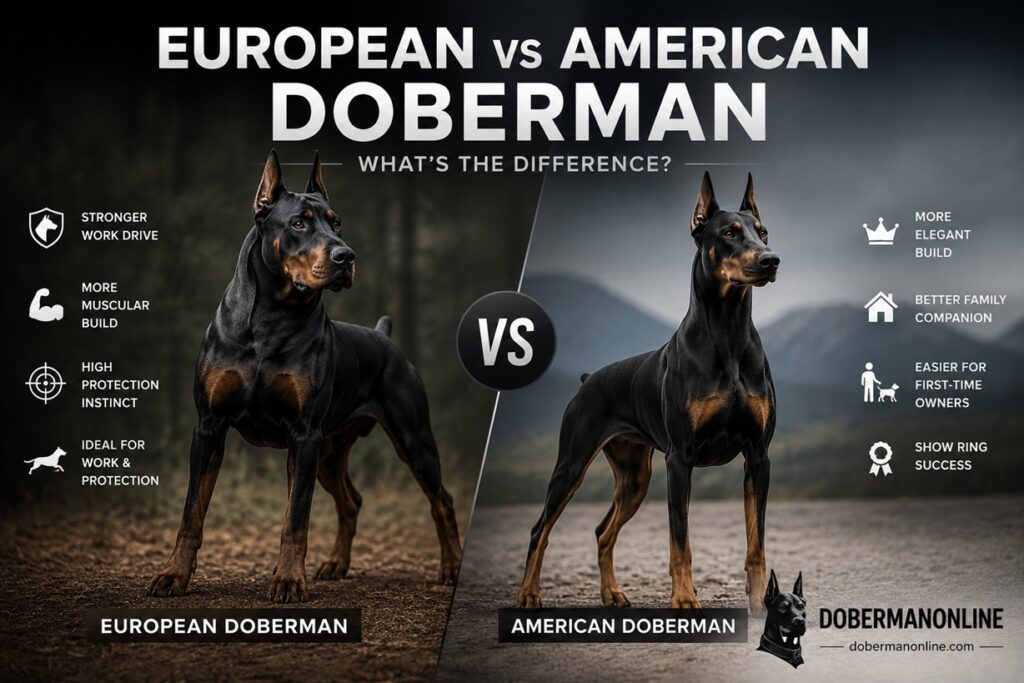
European vs American Doberman at a Glance
| Feature | European Doberman | American Doberman |
|---|---|---|
| Build | Larger, heavier, muscular | Leaner, elegant, refined |
| Temperament | Confident, intense, driven | Friendly, balanced, adaptable |
| Energy Level | Very High | High |
| Working Ability | Excellent | Excellent but less intense |
| Protection Instinct | Very Strong | Strong |
| Family Suitability | Experienced owners | First-time owners with commitment |
| Trainability | Outstanding | Outstanding |
| Exercise Needs | Extensive | High but slightly easier to manage |
| AKC Appearance | Less emphasized | Show-oriented |
| FCI Appearance | Breed standard | Original European standard |
History of the Two Bloodlines
Both the European and American Doberman trace their ancestry back to Karl Friedrich Louis Dobermann, a German tax collector who sought to develop the ideal protection dog in the late 1800s.
Over time, however, breeding programs evolved differently on each continent.
European breeding programs remained focused on preserving the Doberman’s original working purpose. Dogs were selected for courage, endurance, stability, and performance in protection sports, police work, and military service.
American breeders, while still valuing intelligence and athleticism, increasingly emphasized graceful movement, refined structure, and predictable family temperament. This shift was influenced by dog shows and companion ownership.
Today, both bloodlines remain purebred Dobermans, but their differences are the result of decades of selective breeding rather than separate breeds.
Appearance Differences
One of the easiest ways to distinguish the two bloodlines is by their overall appearance.
European Dobermans generally have a heavier frame with thicker bone structure, broader chests, larger heads, and stronger necks. Their overall impression is one of raw strength and athletic power.
American Dobermans appear more refined and elegant. They usually have a narrower head, lighter bone structure, longer neck, and smoother body lines. Their movement is fluid and graceful, making them highly competitive in conformation shows.
Although these differences may seem subtle in photographs, they become much more noticeable when the dogs are seen side by side.
Size Comparison
| Measurement | European | American |
|---|---|---|
| Male Height | 27–28 inches | 26–28 inches |
| Female Height | 25–27 inches | 24–26 inches |
| Male Weight | 90–110 lbs | 75–100 lbs |
| Female Weight | 70–90 lbs | 60–90 lbs |
European Dobermans generally carry significantly more muscle mass, giving them a noticeably stronger appearance without necessarily being much taller.
Head and Facial Features
The head shape is another area where the differences become apparent.
European Dobermans typically have:
- Broader skull
- Deeper muzzle
- More pronounced stop
- Strong jaw muscles
- Fuller cheeks
American Dobermans usually display:
- Narrower head
- Longer muzzle
- More refined facial expression
- Cleaner profile
- Elegant neck transition
Neither style is considered universally superior. Instead, each reflects different breeding priorities established by kennel clubs and breeders over many decades.
Temperament Comparison
Temperament is one of the biggest differences between European and American Dobermans. While both are intelligent, loyal, and naturally protective, their personalities have been shaped by different breeding goals over several decades.
European Dobermans are generally more intense, confident, and driven. They thrive when given a job to do and often display stronger working instincts. Many excel in protection sports, obedience competitions, search and rescue, and service work because they enjoy physical and mental challenges.
American Dobermans, on the other hand, tend to have a slightly softer temperament. They are often easier to manage in everyday family life while still retaining the breed’s intelligence and protective nature. Their calmer demeanor makes them popular companions for active households.
Neither temperament is better than the other. The ideal choice depends on your experience, lifestyle, and the amount of time you can dedicate to training and exercise.
Protection Instinct
Dobermans are famous for their natural guarding ability, but the strength of this instinct often varies between the two bloodlines.
European Dobermans are usually bred with working ability as a primary goal. As a result, they often display:
- Strong territorial awareness
- High confidence around strangers
- Greater defensive drive
- Excellent courage under pressure
- Exceptional performance in protection work
American Dobermans are also protective but typically show a more measured response. They are generally more social and less likely to remain constantly alert without a reason.
For most families, an American Doberman provides more than enough protection while being easier to manage in public settings.
Which Bloodline Is Better for Families?
Both bloodlines can become wonderful family companions when properly trained and socialized.
However, their daily lifestyles may differ.
European Doberman
Pros:
- Extremely loyal
- Excellent home guardian
- Highly confident
- Thrives with experienced owners
Challenges:
- Requires significant exercise
- Needs advanced mental stimulation
- Can become destructive if bored
- Better suited for active lifestyles
American Doberman
Pros:
- Gentle with family members
- Slightly easier for first-time Doberman owners
- Adapts well to suburban living
- Usually calmer indoors after exercise
Challenges:
- Still requires daily activity
- Can develop separation anxiety if left alone too long
- Needs consistent training from puppyhood
For families looking primarily for a companion dog, the American Doberman is often the easier choice. Families seeking a serious working partner may prefer the European bloodline.
Intelligence and Trainability
Regardless of bloodline, Dobermans rank among the smartest dog breeds in the world.
Both types learn commands quickly and respond exceptionally well to positive reinforcement.
European Dobermans often possess:
- Higher working drive
- Stronger focus
- Greater endurance during training
- Faster learning under experienced handlers
American Dobermans commonly display:
- Excellent obedience
- High willingness to please
- Easier adaptability
- Better focus in household environments
Training success depends far more on consistency than on bloodline.
Early socialization, clear rules, and daily practice are essential for either type.
Exercise Requirements
Neither European nor American Dobermans are low-energy dogs.
However, European bloodlines generally require more physical and mental activity.
European Doberman
Recommended daily activity:
- 2–3 hours of exercise
- Advanced obedience
- Agility
- Protection sports
- Running
- Hiking
- Interactive games
American Doberman
Recommended daily activity:
- 1.5–2 hours of exercise
- Long walks
- Fetch
- Basic obedience
- Puzzle toys
- Moderate running
Owners who cannot consistently meet these exercise requirements may struggle with unwanted behaviors such as chewing, excessive barking, or hyperactivity.
Health Differences
Both bloodlines share many inherited health risks because they belong to the same breed.
Common concerns include:
- Dilated Cardiomyopathy (DCM)
- Hip Dysplasia
- Von Willebrand Disease
- Hypothyroidism
- Wobbler Syndrome
- Gastric Dilatation-Volvulus (Bloat)
European working breeders often perform extensive health testing before breeding, although responsible American breeders follow similar screening programs.
Choosing a breeder who performs cardiac testing, hip evaluations, thyroid screening, and genetic testing is far more important than choosing a particular bloodline.
Lifespan Comparison
| Bloodline | Average Lifespan |
|---|---|
| European Doberman | 10–12 years |
| American Doberman | 10–12 years |
Lifestyle, nutrition, preventive veterinary care, genetics, and exercise have a much greater influence on longevity than bloodline alone.
A well-cared-for Doberman from either line can enjoy a long, healthy, and active life.
Which Doberman Is Better for First-Time Owners?
For most first-time Doberman owners, the American bloodline is generally considered easier to manage.
Reasons include:
- Slightly calmer personality
- Easier adaptability
- Softer temperament
- Less demanding working drive
- More relaxed in everyday family life
European Dobermans can also be excellent companions, but they are usually better suited for owners who have previous experience with large, energetic working breeds and can provide structured training and daily challenges.
Pros and Cons of a European Doberman
Pros
- Exceptional working ability
- Highly confident and courageous
- Outstanding trainability
- Strong protective instincts
- Excellent athletic performance
- Loyal and deeply bonded to their owner
- Ideal for experienced handlers
Cons
- Requires extensive daily exercise
- Needs constant mental stimulation
- Can be challenging for inexperienced owners
- May become frustrated without a structured routine
- Often has a stronger prey and defense drive
Pros and Cons of an American Doberman
Pros
- Elegant appearance
- Friendly and adaptable personality
- Excellent family companion
- Easier for first-time Doberman owners
- Highly intelligent and obedient
- Strong protection instinct without excessive intensity
Cons
- Still requires significant daily exercise
- Can suffer from separation anxiety
- Needs early socialization
- Sensitive to inconsistent training
- Less suited for demanding protection sports than many European working lines
Side-by-Side Comparison
| Category | European Doberman | American Doberman |
|---|---|---|
| Overall Build | Powerful and muscular | Elegant and refined |
| Working Drive | Very High | High |
| Family Companion | Excellent | Excellent |
| Protection Ability | Outstanding | Excellent |
| Trainability | Outstanding | Outstanding |
| Energy Level | Very High | High |
| Ease for Beginners | Moderate | Better |
| Mental Stimulation Needs | Very High | High |
| Adaptability | Moderate | Excellent |
| Show Ring Success | Less emphasized | Strong emphasis |
Which Doberman Should You Choose?
There is no universally “better” Doberman. Both bloodlines are exceptional dogs, but they excel in different environments.
Choose a European Doberman if you:
- Want a serious working dog
- Enjoy advanced obedience or dog sports
- Have experience with high-drive breeds
- Can provide daily physical and mental challenges
- Need a highly capable protection companion
Choose an American Doberman if you:
- Want an active family companion
- Prefer a slightly more relaxed temperament
- Are a first-time Doberman owner
- Plan to participate in obedience or conformation shows
- Want a dog that balances protection with everyday adaptability
The most important factor is not whether the dog comes from a European or American bloodline—it is the quality of the breeder, proper socialization, consistent training, and responsible ownership.
Frequently Asked Questions
Is a European Doberman more aggressive than an American Doberman?
No. European Dobermans are generally more driven and confident, but they are not naturally more aggressive. Proper breeding, early socialization, and consistent training play a much larger role in temperament than bloodline alone.
Which Doberman is bigger?
European Dobermans are typically heavier, more muscular, and have a broader frame. American Dobermans are usually leaner and more refined in appearance.
Are American Dobermans easier to train?
Both bloodlines are highly intelligent and trainable. American Dobermans are often considered slightly easier for first-time owners because of their balanced temperament, while European Dobermans may require more experienced handling due to their stronger working drive.
Which Doberman is better for protection?
European Dobermans are generally preferred for protection sports and demanding working roles because they are often bred with a stronger focus on courage, endurance, and working ability. However, American Dobermans are still naturally protective and make excellent family guardians.
Do both bloodlines have the same health problems?
Yes. Both European and American Dobermans can be affected by inherited conditions such as Dilated Cardiomyopathy (DCM), Von Willebrand Disease, hip dysplasia, hypothyroidism, and bloat. Responsible breeding and routine health testing are essential regardless of bloodline.
Can European and American Dobermans live together?
Yes. With proper introductions, training, and socialization, European and American Dobermans can live together successfully. Their compatibility depends more on individual temperament and upbringing than on bloodline differences.